As an Amazon Associate I earn from qualifying purchases and sometimes recommend products from other sellers at no extra cost you. For more details see my disclosure policy and privacy policy.
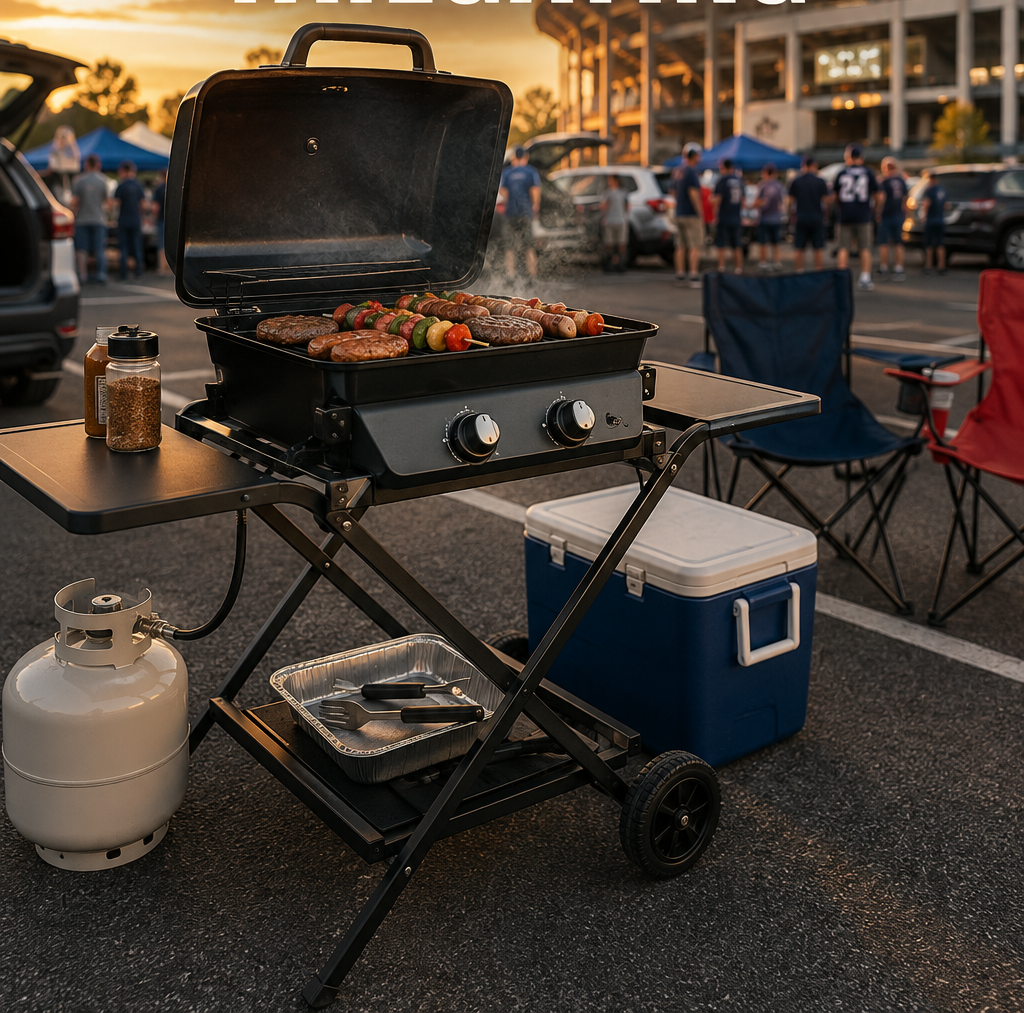
Tailgating puts a grill through a different kind of test than your patio does. You’ve got a limited setup window, a parking spot instead of a deck, and a crew that’s hungry before kickoff.
A grill that’s technically “portable” isn’t automatically tailgate-ready. There’s a real difference between a grill you’d carry to a campsite once a summer and one you can pull out of a trunk, light, and be cooking on before everyone else finds the cooler.
This roundup is built for the parking lot, not the backyard. We’re covering setup speed, weight you can lift solo, how much trunk space a grill eats up, and the fuel-type rules some venues enforce that can wreck your plans if you don’t check ahead.
What Makes a Grill Actually Tailgate-Ready
Three things separate a true tailgate grill from a grill that’s merely small.
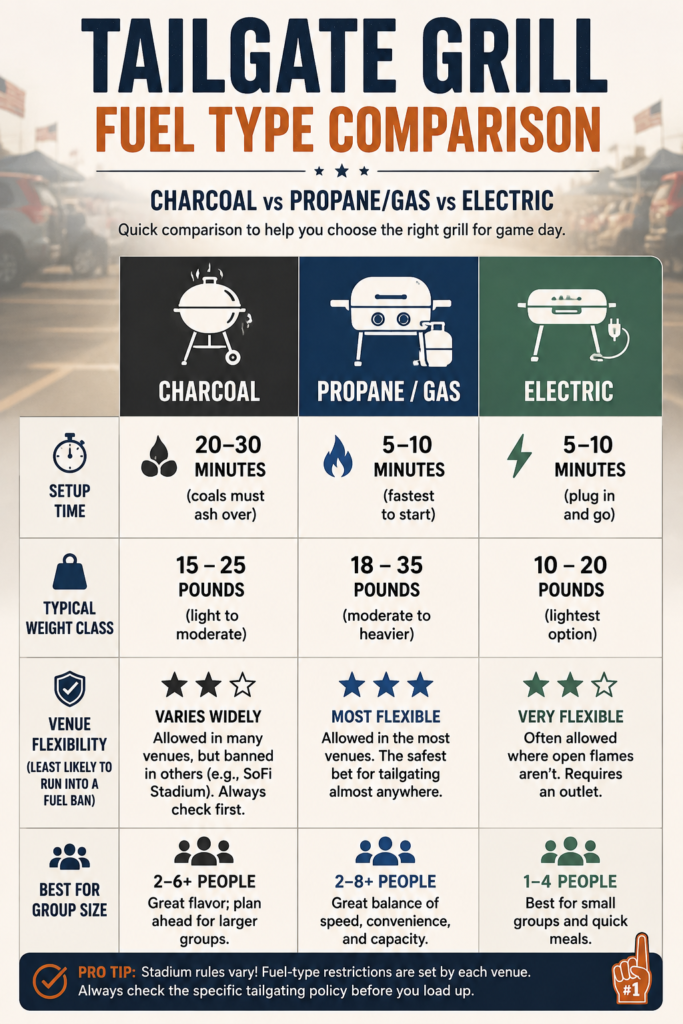
Setup time. The best tailgate grills go from trunk to cooking in well under 10 minutes. Charcoal models need more lead time since the coals have to ash over first, so budget closer to 20-30 minutes.
Weight and footprint. You’re lifting this in and out of a vehicle, possibly across a gravel lot, by yourself. A grill with an integrated stand or folding cart is worth the extra few pounds if it means you’re not hauling a hot firebox at waist height.
Wind performance. Parking lots are open and exposed. A grill with a lid that seals well and burners that hold their heat in a breeze saves a lot of frustration compared to one built for a sheltered patio.
Check Your Vehicle Before You Check Out
Think about where the grill actually lives on game day. A grill with folding legs and a low profile tucks into a trunk or SUV cargo area far more easily than one with a rigid stand.
If you’re driving a smaller sedan, prioritize a grill that breaks down flat or fits in a tote-style case. A truck bed or larger SUV gives you room to go with a full-size model like the Weber Traveler instead.
Propane tanks need to travel upright and secured, not loose in a trunk. If you tailgate every week and have a trailer hitch, hitch-mounted grill systems also exist that mount to the vehicle itself and free up all your cargo space for coolers and chairs.
Venue Rules Vary. Always Check Before You Load Up
This is the part a lot of tailgate grill guides skip, and it matters more than any spec sheet. Fuel-type restrictions are set by the individual stadium or venue, not by any universal rule, and they can flip your grill from allowed to banned depending on where you’re parked.
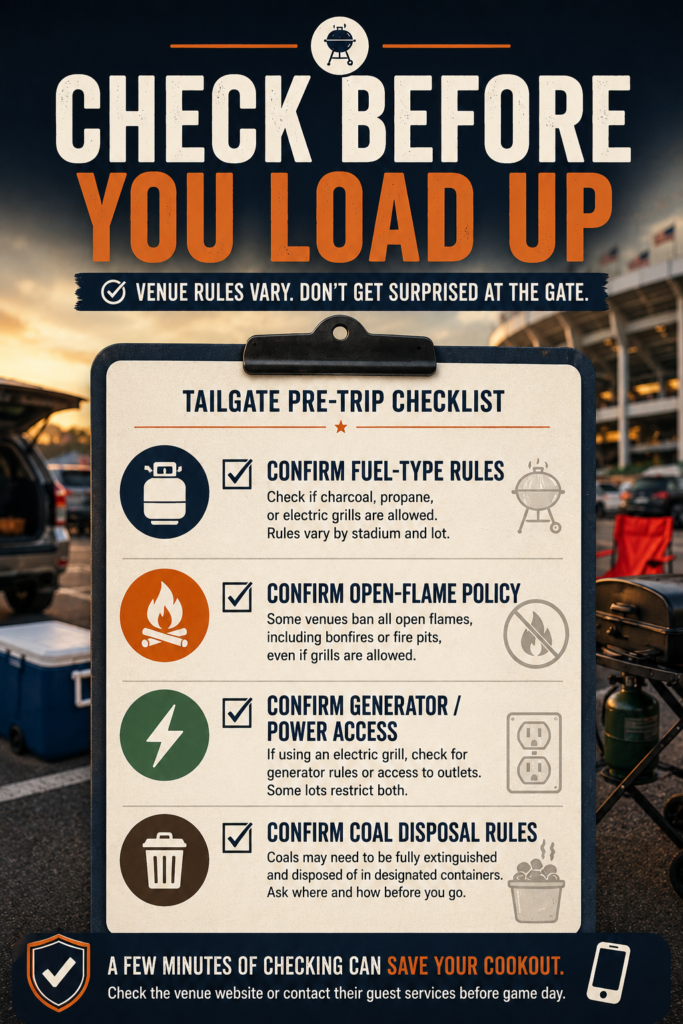
A few real examples show how much this varies:
- At AT&T Stadium (Cowboys) and at Hard Rock Stadium for the 2026 CFP National Championship, both charcoal and propane grills are permitted, though open fires like bonfires and fire pits are not.
- SoFi Stadium prohibits charcoal grills, wood stoves, and open-pit fires entirely, which pushes tailgaters there toward propane or electric.
- Globe Life Field flips the usual assumption: charcoal grills are allowed in grassy areas, but propane cooktops and stoves are banned for safety reasons.
- The Buffalo Bills allow charcoal grills and elevated fires, but coals must be fully extinguished before you head into the stadium.
Don’t assume your usual setup will be welcome at a new venue, and don’t assume charcoal is always the default option. Check the specific stadium or lot’s tailgating policy before you load the truck, since rules can also change for high-profile games with tighter security.
Top Charcoal Picks for Tailgating
Charcoal still wins on flavor for a lot of tailgaters, and it’s often the cheapest way in if your venue allows it.
Budget pick: Weber Go-Anywhere Portable Charcoal Grill. A longtime tailgate staple. It’s light enough to carry one-handed and folds down small enough to stash in a trunk without eating your whole cargo area. It’s sized for a smaller group, so plan for a longer cook or a second batch if you’re feeding more than four or five people.
Premium pick: PK Grills PKGO. Cast aluminum construction instead of thin steel means this one is built to survive years of parking-lot use without rusting. Its two-zone setup lets you sear and hold food warm at once, which matters when your crew doesn’t all show up hungry together. It costs more than the Weber, but reviewers treat it as a buy-it-once grill.
For backyard-grade charcoal picks, our roundup of the best charcoal grills under $300 covers larger models worth considering once football season wraps.
Top Propane and Gas Picks for Tailgating
Propane is the fuel type most likely to be allowed at whatever venue you’re headed to, and it’s the fastest to light.
Budget pick: Cuisinart Grillster Portable Gas Grill. About as light and simple as a real gas grill gets, small enough to fit in a tote bag and quick to fire up. It won’t feed a crowd the size a full patio grill would, but for two to four people it’s an easy, inexpensive way to get hot food fast.
Premium pick: Weber Traveler. The grill a lot of serious tailgaters graduate to. It has a full-size cooking grate, cast iron grates for a real sear, and a folding wheeled cart that’s easy to move one-handed. It’s the priciest pick here, but if you tailgate more than a couple times a season, the extra cooking space and quick setup pay off.
For gas grills you’ll use at home the rest of the year, check our guide to the best gas grills under $500.
Top Electric Picks for Tailgating
Electric grills solve the venue-restriction problem outright, since most stadiums that ban charcoal or propane still allow electric cooking with the right power source.
Weber Lumin Compact. A genuinely small, plug-in electric grill built for situations where open flame isn’t an option. It needs an outlet or a portable power station, but at a venue with strict fuel rules, it removes the guesswork entirely.
Ninja Woodfire Outdoor Grill & Smoker. This one does more than grill. It smokes, air fries, and roasts, all run off a standard 120-volt outlet or generator. It’s heavier than the Lumin, but the versatility is a strong pick if you want more than burgers and dogs out of your setup.
Electric grills only work if you’ve got power at the lot, whether that’s a generator, a portable power station, or an outlet at the venue. Confirm that before you count on one.
Budget vs Premium: What You’re Actually Paying For
If you’re tailgating a handful of times a year, the budget picks (the Weber Go-Anywhere or the Cuisinart Grillster) will do the job without a big investment. They’re light, cheap to replace, and easy to store in the off-season.
If tailgating is a weekly ritual, the premium picks (the PK Grills PKGO or the Weber Traveler) earn their price through more cooking space, faster recovery between rounds of food, and materials that hold up to years of loading and unloading.
Either way, don’t overbuy on size. A grill built for a backyard cookout is usually the wrong tool for a parking lot, even with wheels.
Pack-Down and Cleanup Tips for the Parking Lot
A few habits make teardown faster and keep you on good terms with whoever parks next to you:
- Let coals or grates cool before you pack anything away. Rushing this is how gear bags get scorched.
- Bag spent charcoal ash separately in a dedicated metal container, never straight into a regular trash bag while still warm.
- Line drip trays with foil ahead of time so cleanup is a quick toss instead of a scrub-down.
- Bring a roll of paper towels or wet wipes and a couple of extra trash bags. You’ll use more than you think.
- Keep a pair of long grilling tongs on hand for moving hot grates and coals safely. Our guide to the best grilling tongs covers a few options built for exactly this kind of handling.
- Before you eat, confirm your food actually hit a safe internal temperature rather than eyeballing it. A fast digital read, like what you get from the Lavatools Javelin Pro Duo instant-read thermometer, takes the guesswork out in a few seconds flat. For more on safe handling in an outdoor, un-refrigerated setting, our food safety tips for grilling outdoors are worth a read before game day.
Once you’ve nailed down setup, fuel type, and cleanup, tailgating gets a lot less stressful and a lot more about the food. If you’re building a bigger cookout around a long weekend instead of a single game, our Labor Day BBQ planning guide has a menu and timeline you can borrow from.
Whatever grill you land on, the goal is the same: less time fighting your gear, more time tailgating.