As an Amazon Associate I earn from qualifying purchases and sometimes recommend products from other sellers at no extra cost you. For more details see my disclosure policy and privacy policy.
If you only read one line of this guide, make it this one: the Weber Spirit E-310 is the consensus top pick for grillers upgrading their budget under $500. Reliable ignition, even heat across the grates, and a build that realistically holds up eight to ten years with basic care put it ahead of the rest of the field. But the right grill for you still depends on how many burners you actually need, how often you’re cooking for a crowd, and whether long-term reliability matters more to you than a longer feature list.
This guide covers five gas grills between roughly $150 and $500, what genuinely separates a good grill from a mediocre one at this price, and what’s just marketing noise. Prices shift constantly on Amazon and at big-box retailers, so treat the figures below as a starting point and confirm current pricing before you buy.
🔥 The Top Pick: Weber Spirit E-310
The Weber Spirit E-310 is a three-burner propane grill currently running around $449 to $499 depending on retailer and promotions. It’s the model most buying guides converge on for good reason.
Weber’s grates and burner tubes are built to hold up over years of regular use, not just a season or two. The Snap-Jet ignition lights reliably, which sounds minor until you’ve fought with a grill that won’t catch on a windy evening.
If you’re replacing a grill that’s on its last legs and want something you won’t think about again for close to a decade, this is the one to buy.
The E-310 also comes in a handful of colour options at most retailers, and Weber’s iGrill temperature probe accessory works with it if you want to add smart monitoring later. Neither is essential, but both are worth knowing about before you buy elsewhere for a feature you could have added on afterwards.
🍖 Five Gas Grills Worth Considering Under $500
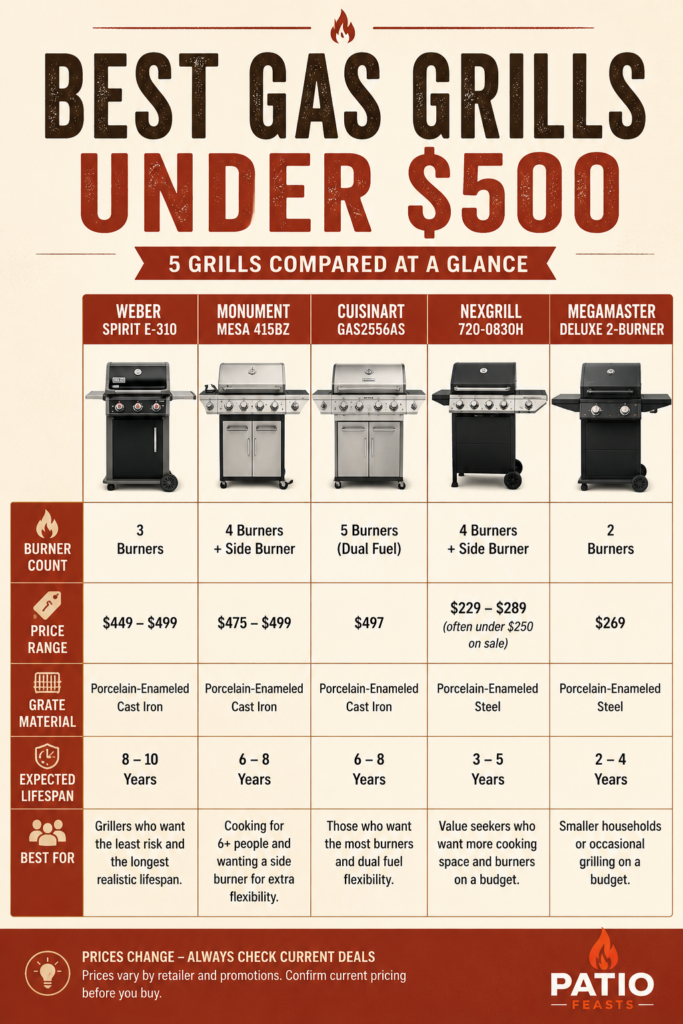
Weber Spirit E-310 (three burners, around $449 to $499): the safest pick, covered above. Best if you want the least risk and the longest realistic lifespan.
Monument Grills Mesa 415BZ (four burners plus a side burner, around $475 to $499): more cooking space and a side burner for sauces or sides, at a similar price to the Weber. A solid choice if you regularly cook for six or more people and want the side burner’s flexibility.
Cuisinart GAS2556AS (five burners, dual fuel, around $497): the most burners on this list and the option to run on natural gas instead of propane if your patio has a gas line. Worth it specifically for that dual-fuel flexibility, less so if you’ll never use the natural gas hookup.
Nexgrill 720-0830H (four burners plus a side burner, currently around $229 to $289): strong value for the burner count and cooking space, and it regularly drops below $250 during sales. The trade-off is a lighter-gauge build than the Weber or Monument, so expect a shorter realistic lifespan.
Megamaster Deluxe 2-Burner (around $269): the true budget option here. Good for smaller households or occasional grilling, not built for regularly feeding a crowd.
On cooking space, the Cuisinart and Nexgrill both offer the most total square inches for the price, which matters if you’re regularly cooking for eight or more people at once. The Weber and Monument sit in the middle at a size that comfortably handles a family cookout without feeling cramped, and the Megamaster is sized for smaller households rather than large gatherings. None of these figures matter much on their own though; they’re only useful alongside the grate material and heat distribution points covered next.
⛽ Propane or Natural Gas: Does It Matter Here?
Four of the five grills on this list run on propane tanks, which is the standard setup for most patios and decks. The Cuisinart GAS2556AS is the exception, offering dual fuel so it can be converted to run off a natural gas line if your house already has one plumbed to the patio.
If you don’t have a gas line out there already, the conversion cost and hassle usually aren’t worth it just to save on propane tank refills. Where dual fuel earns its keep is for people who already grill often enough that running out of propane mid-cook is a genuine annoyance, in which case a permanent gas line removes that problem entirely.
For everyone else, propane remains the simpler and more flexible option, since a spare tank costs little and travels with you if you move house or want to grill somewhere other than your usual spot.
🛠️ What Actually Matters (and What’s Just Marketing)
BTU count is the number every listing leads with, and it’s the one to weight the least. A grill with a higher BTU rating isn’t necessarily hotter or more even at the grate; it’s just burning more gas to get there, which mostly affects your propane bill.
What actually matters is grate material. Cast iron or heavy stainless grates hold and distribute heat more evenly than thin stamped steel, and they matter far more to your actual cooking results than the BTU number does.
Even heat distribution across the whole cooking surface matters too. A grill that runs hot in the middle and cool at the edges will fight you on anything beyond a couple of burgers at a time.
Build quality and ignition reliability round out the list. A grill with thin steel construction and a temperamental igniter will feel worse to use daily than a lower-BTU grill built with heavier materials, regardless of what the spec sheet says.
Lid insulation is another point worth checking rather than assuming. A well-fitted, properly insulated lid holds heat steady for indirect cooking, while a thin or loosely fitted one lets heat escape and makes the grill work harder (and burn more gas) to hold the same temperature.
Wheels and casters matter more than they sound like they should. A grill with sturdy locking casters is far easier to reposition for cleaning or storage than one with cheap plastic wheels that seize up or crack within a year or two of outdoor exposure.
⚖️ Realistic Expectations at This Price Point
None of these grills are built like a $1,500 outdoor kitchen unit, and it’s worth being upfront about what corners get cut at this price range.
Steel gauge is the biggest one. Cheaper grills use thinner metal that dents and rusts faster, particularly around the firebox and lid, which is why the Weber and Monument (heavier gauge steel) tend to outlast the Nexgrill and Megamaster.
Accessories and warranty length scale with price too. The Weber’s warranty on burners and grates runs considerably longer than what you’ll get on the budget end of this list, which reflects the manufacturer’s own confidence in how long the parts will hold up.
Realistically, budget-tier grills in the $200 to $300 range last around three to five years with regular use before rust or burner failure sets in. Grills in the $400 to $500 range, built with heavier steel, tend to run eight to ten years with basic maintenance. That gap is worth factoring into the price difference rather than treating $250 saved today as pure savings.
Warranty length is a useful shortcut here too, since it reflects what the manufacturer itself expects from the build. Weber typically backs its burner tubes and grates with a considerably longer warranty than the budget brands on this list offer, which lines up with the real-world lifespan difference rather than being just a sales tactic.
A basic grill cover is worth adding to any of these five picks regardless of price, since it’s a small cost that meaningfully slows the rust and weather damage that ends most gas grills’ useful life early.
🙋 Which Grill Suits You?
There’s no single “best” grill on this list, only the one that matches how you actually cook and how long you want it to last. Working through these questions honestly will save you from either overspending on features you won’t use or underspending on a grill that won’t survive your usual grilling season.
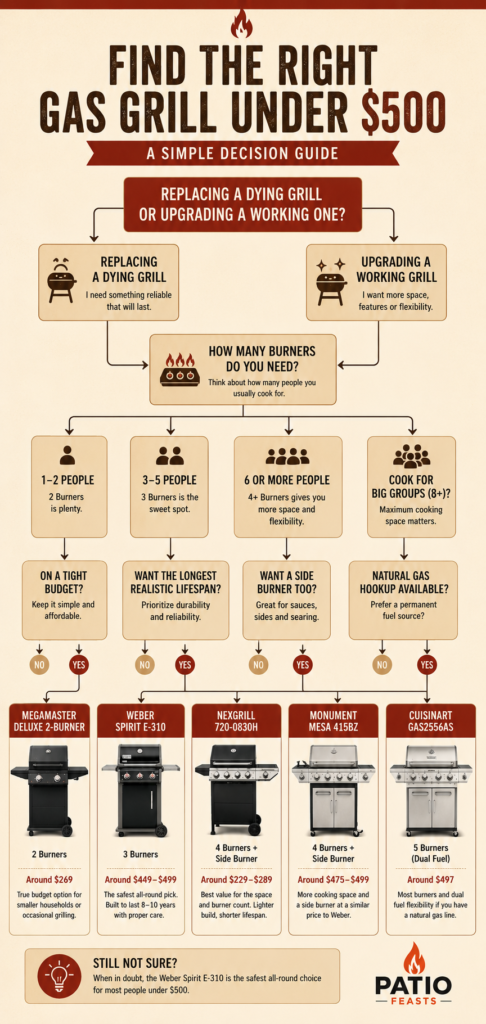
If you’re replacing a grill that’s genuinely on its way out and want to stop thinking about it, the Weber Spirit E-310 or the Monument Mesa 415BZ are both built to last the better part of a decade.
If this is still a solid upgrade from a starter grill rather than an emergency replacement, the Nexgrill 720-0830H gives you four burners and a side burner for well under $300, which is hard to beat on value even with the shorter expected lifespan.
If your patio is tight on space, a full-size four or five burner grill might be more than you need. Our guide to the best small barbecues when you don’t have much space covers compact options that still deliver real cooking performance.
If you regularly cook for a large group, whether that’s weekly family dinners or frequent weekend get-togethers, the Cuisinart GAS2556AS’s five burners and larger cooking surface give you the most room to work with multiple dishes at once without constantly juggling grate space.
And if you’re weighing gas against charcoal entirely, that’s a separate decision worth its own research before you commit to this list. (We’re finalising a dedicated charcoal grill comparison under $300, worth checking once it’s live.)
Whatever you land on, the grill is only half the setup. If your outdoor space itself needs work before it’s ready for regular use, our backyard BBQ patio ideas guide has practical ways to make the space around the grill work harder too.
🧹 Keep It Running: A Quick Maintenance Note
Whichever grill you pick, a bit of regular maintenance is what actually gets you to that eight to ten year range rather than the three to five year one.
Cleaning the grates after each use and giving the whole grill a proper deep clean each spring makes the biggest difference to burner life and rust prevention. Our spring grill cleaning guide walks through the ten steps worth doing before the season really gets going.
📝 The Bottom Line
For most people upgrading from a starter grill, the Weber Spirit E-310 is the safest all-round pick under $500, with the Monument Mesa 415BZ a close second if you want more cooking space and a side burner. Focus your buying decision on grate material, even heat distribution, and build quality rather than BTU count, and budget for a shorter lifespan on anything under $300 compared with the $400 to $500 tier.
None of these five grills are the wrong choice outright. The wrong choice is picking based on the biggest BTU number on the box rather than the grate material, build quality, and expected lifespan that actually determine how the grill performs and how long it lasts.