As an Amazon Associate I earn from qualifying purchases and sometimes recommend products from other sellers at no extra cost you. For more details see my disclosure policy and privacy policy.
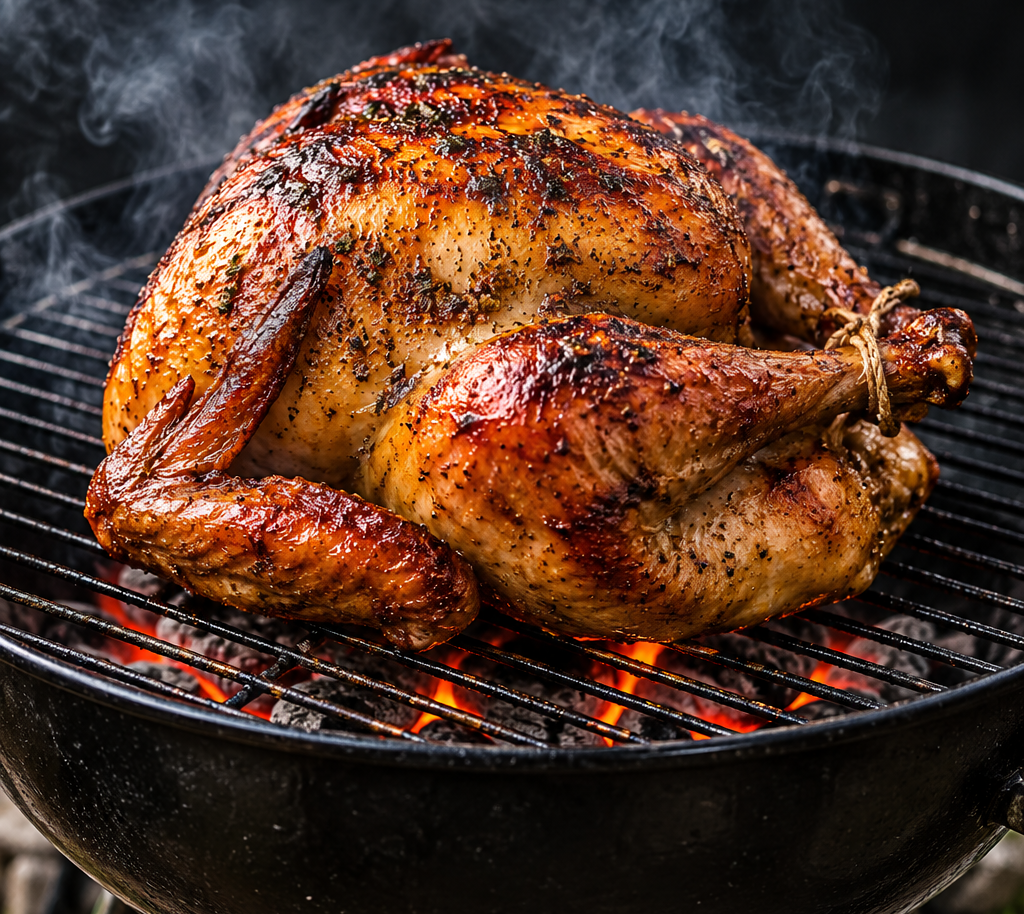
Picture it: the oven is packed with sides, the kitchen is hot, and a perfectly golden turkey is sitting out on the patio, kissed with a little charcoal smoke. Grilling the bird is one of the best things you can do for your Thanksgiving, because it frees up your oven and keeps the heat outside.
It is also a little nerve-wracking if you have never done it. Will it cook through? How long will it take? What if the coals die halfway?
This guide gives you the answers in plain steps. You get the grill setup, USDA-based times, the temperature that actually tells you when it is done, and a timeline for the big day. Treat the time estimates as a guide and the thermometer as the rule.
🦃 Is Your Grill and Bird a Good Fit?
Before you buy anything, check that the turkey and the grill suit each other. Three things matter most: size, thaw and stuffing.
Size
The USDA Food Safety and Inspection Service (FSIS) suggests grilling a whole turkey in the 8 to 16 pound range. Bigger birds take so long that the grill struggles to hold steady heat, and the meat spends too much time in the temperature danger zone.
You also need physical room. The lid must close fully with the bird in place, and the turkey should not touch the lid or the sides. A standard 22-inch kettle or a full-size gas grill with a lid usually works for a bird up to 12 pounds, and a larger grill handles the rest.
Fully thawed
A frozen or half-frozen center will not reach a safe temperature in time. The USDA says the turkey must be completely thawed before it goes on the grill.
The safest way to thaw is in the refrigerator, allowing about 24 hours for every 4 to 5 pounds. A 14-pound bird needs roughly three days.
Unstuffed
Keep the stuffing in a separate dish. USDA advises against stuffing a turkey cooked on the grill, because the low cooking temperature means the stuffing may not reach 165°F (74°C) in time. Bake it in the oven instead, which is easier now that the bird is outside.
🔥 How to Set Up for Indirect Grilling
Whole turkeys cook best with indirect heat. That means the fire sits to the sides, and the turkey sits over an empty spot. If you want a refresher on why, our guide to direct vs. indirect grilling covers the basics.
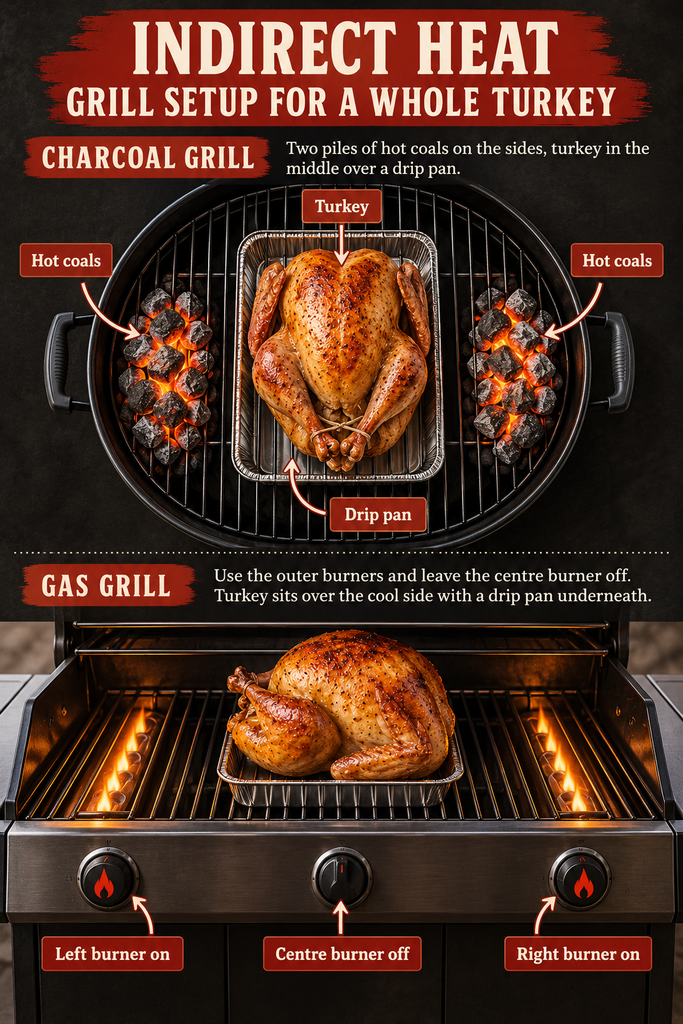
Charcoal grill setup
Light your charcoal in a chimney, then pour the hot coals into two piles on opposite sides of the grill. Place a disposable foil drip pan in the center, between the coals, and pour in about a cup of water.
A charcoal chimney starter lights coals faster and more evenly than lighter fluid. Set the cooking grate over the coals and put the turkey, breast side up, directly over the pan.
Gas grill setup
Turn on the burners on the outer sides and leave the center burner off. If your grill has only two burners, light one and put the bird on the cool side. Set the drip pan under the grate beneath the turkey.
Close the lid, preheat, and let the grill settle to a steady temperature before the bird goes on.
What temperature to aim for
USDA says to keep the air temperature inside the grill between 225°F and 300°F (107°C and 149°C). Many home cooks run closer to 300°F (149°C), since the bird browns better and the cold air outside pulls heat away in November.
If your grill runs hotter than that, the turkey will finish sooner than the time chart below suggests. Start checking the temperature early so the skin does not burn before the middle is done.
⏱️ How Long to Grill a Turkey Per Pound
USDA estimates 15 to 18 minutes per pound for a turkey in a covered grill. Use this as a rough plan for the day, not as a way to decide when it is done.
| Turkey weight | Estimated time |
|---|---|
| 8 lb (3.6 kg) | 2 to 2 1/2 hours |
| 10 lb (4.5 kg) | 2 1/2 to 3 hours |
| 12 lb (5.4 kg) | 3 to 3 1/2 hours |
| 14 lb (6.4 kg) | 3 1/2 to 4 1/4 hours |
| 16 lb (7.3 kg) | 4 to 4 3/4 hours |
These are estimates based on 15 to 18 minutes per pound and rounded to the nearest quarter hour. Wind, cold air, lid openings and how hot your fire runs can shift them by a lot.
Plan for the long end of the range, and add a buffer. A turkey that finishes early can rest and stay warm, but a turkey that finishes late holds up dinner.
🌡️ Temperature Is the Rule: Where to Check
Time is the estimate. Temperature is the answer. The turkey is done when a food thermometer reads 165°F (74°C) in three places: the innermost part of the thigh, the innermost part of the wing and the thickest part of the breast.
Check all three. The thigh is usually the last to finish, so if the breast is at temperature and the thigh is not, keep cooking.
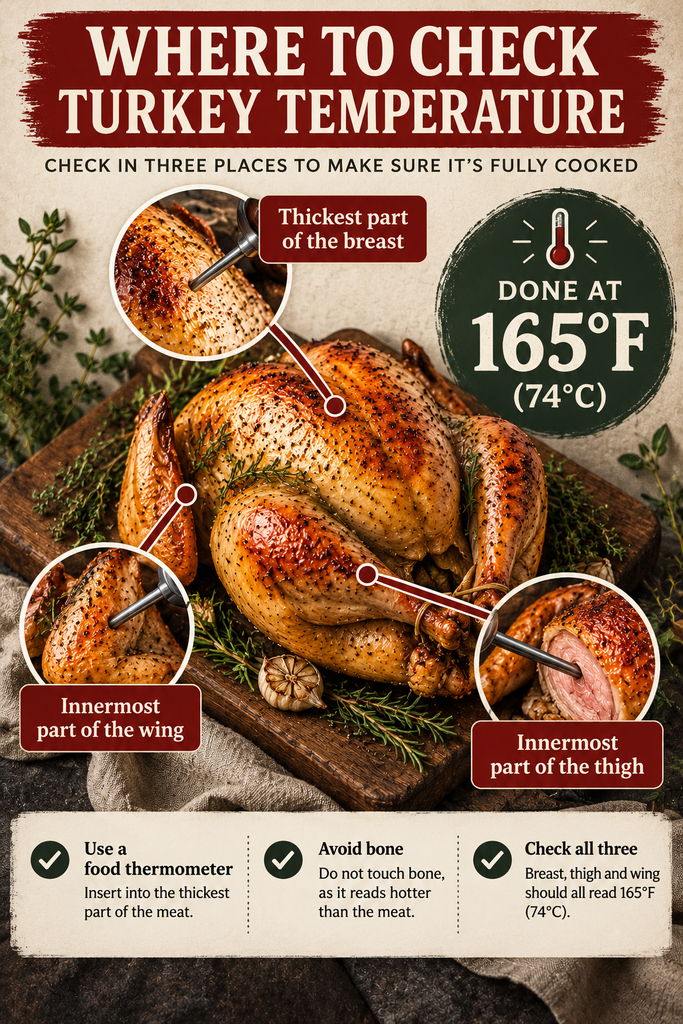
How to take the reading
Slide the probe into the thickest part of the meat, aiming for the center. Do not touch bone, because bone reads hotter than the surrounding meat and can fool you.
An instant-read thermometer gives you a number in a few seconds, so you are not holding the lid open for long. If you are shopping, our best meat thermometer for grilling guide compares your options.
Don’t trust the pop-up timer or the clock
Pop-up timers can be inaccurate, and minutes per pound is only an estimate. The meat and the thermometer are the only things that tell you for sure.
If you have time to spare, check the temperature about 45 minutes before the earliest estimate. You can always keep cooking.
🪵 Cooking Tips for a Better Bird
A few small steps make a big difference in how the turkey tastes and looks.
Pat the skin dry
Pat the turkey dry with paper towels before it goes on the grill. Dry skin crisps, while wet skin steams and turns pale and rubbery. For extra crispness, leave the unwrapped bird in the refrigerator for a few hours first.
Season and oil the skin
Rub the skin all over with oil or softened butter, then season generously with salt, pepper and your favorite herbs. A little fat helps the skin brown and keeps the seasoning in place.
Keep the seasoning simple. Salt, pepper, garlic, paprika and a few herbs are plenty.
Keep the lid closed
Every time you lift the lid, the grill loses heat and the cooking time stretches. Open it only when you need to check the temperature, add charcoal or rotate the bird.
Refuel charcoal as needed
A charcoal fire will not last for four hours. Add 8 to 10 lit briquettes to each side about once an hour to hold your temperature. Keep a second chimney of coals going on the side so they are ready when you need them.
Wear heat-resistant grill gloves when you tend the coals and move the pan. Hot grates and hot foil are easy to forget about when you are busy.
🍽️ Rest, Carve and Keep It Hot
When the thermometer hits 165°F (74°C) in all three spots, lift the turkey carefully onto a clean platter or cutting board. Use clean tools, not the ones that touched the raw bird.
Tent it loosely with foil and let it rest for about 20 to 30 minutes. Resting lets the juices settle, so the meat stays moist when you carve. The temperature will keep climbing slightly during the rest.
Keeping the turkey hot until serving
Cooked turkey should stay at 140°F (60°C) or above until it is served. If you carve early, cover the sliced meat with foil and keep it in a warm oven, or wrap the platter in towels and set it in a clean, large insulated cooler with the lid closed. This also works well for a tailgate or a trip to a relative’s house.
Our guide on keeping meat warm and moist after grilling uses the same ideas. They work just as well for a bird.
Leftovers
Get leftovers into the refrigerator within two hours of cooking. Slice the meat and store it in shallow containers so it cools quickly. For more on handling food outdoors, read our grilling food safety tips.
🗓️ A Thanksgiving Day Timeline
Planning backward makes the big day calm instead of chaotic. This sample timeline is for a 14-pound turkey and a 4 p.m. dinner. Adjust it to your own bird and meal time.
- Sunday to Monday: Move the frozen turkey to the refrigerator. A 14-pound bird needs about three days to thaw fully.
- Wednesday: Buy charcoal, a drip pan and foil. Check your thermometer. Plan the sides, including make-ahead sides that travel well if you are hosting a crowd.
- Thursday, 9:30 a.m.: Pat the turkey dry and season it, then return it to the refrigerator until the grill is ready. Fill the chimney with charcoal and light it.
- Thursday, 10:15 a.m.: Set up the indirect fire and drip pan. Let the grill settle at your target temperature.
- Thursday, 10:30 a.m.: Put the turkey on, breast side up, and close the lid.
- Thursday, 11:30 a.m. and each hour after: Add fresh coals and check the temperature in the grill.
- Thursday, 1:45 p.m.: Start checking the bird’s temperature in the thigh, wing and breast.
- Thursday, 2:45 p.m. (earliest finish plus buffer): The turkey should be at 165°F (74°C) in all three spots. If not, keep cooking.
- Thursday, 3:00 p.m.: Rest the turkey for 20 to 30 minutes. Use this time to heat the oven for sides and rolls.
- Thursday, 3:45 p.m.: Carve and serve.
You will notice the timeline builds in buffer. That is on purpose. A grilled turkey that rests longer than planned is never a problem, and one that runs behind is.
🛠️ Common Problems and Quick Fixes
Even with a good plan, grilling a turkey throws up the occasional surprise. Here are the most common ones.
Flare-ups
Flare-ups usually come from fat dripping onto hot coals or burners. The drip pan placed under the bird catches most of it. If flames do jump, close the lid and shut the vents partway to starve the fire of oxygen, rather than spraying water on a charcoal fire.
Pale skin
Skin that stays pale is usually too wet or cooking at too low a temperature. Dry it well, oil it, and nudge the grill toward the higher end of the range. In the last 20 to 30 minutes, you can raise the temperature slightly to color the skin, as long as the bird is still cooking through.
Wind and cold weather
Wind and cold pull heat out of the grill fast. Move the grill out of the wind if you can, and expect to add more charcoal than usual. Cooking times stretch in cold air, so lean toward the long end of the estimate and keep checking the grill temperature.
The breast is done but the thigh is not
This is common because dark meat needs more time. Cover the breast loosely with foil to slow its cooking, and keep the lid closed until the thigh reaches 165°F (74°C).
The grill is running out of fuel
Always keep extra charcoal or a spare propane tank on hand. Running out in the middle of the cook is the most avoidable problem on this list. If you use charcoal, keeping a second chimney of coals lit makes topping up easy.
🧭 Final Tips Before You Fire Up the Grill
If you are using a smaller grill, check our guide to the best charcoal grills under $300 for options that handle a larger bird.
A few last reminders before the big day:
- Fully thaw the turkey, and do not stuff it.
- Set up indirect heat with a drip pan in the middle.
- Aim for 225°F to 300°F (107°C to 149°C) in the grill.
- Use 15 to 18 minutes per pound for planning, and the thermometer for deciding.
- Check 165°F (74°C) in the thigh, wing and breast.
- Rest the bird, and keep it hot until you serve.
Grilling a turkey is easier than it sounds once you have a plan. Give yourself time, trust the thermometer, and enjoy the extra oven space.