As an Amazon Associate I earn from qualifying purchases and sometimes recommend products from other sellers at no extra cost you. For more details see my disclosure policy and privacy policy.
If you have ever pulled a rack of baby back ribs off the smoker only to watch it fall apart into shreds the second you picked it up with tongs, you already know the problem. You followed a rib timing method step by step, and the ribs still ended up mushy instead of tender. Most of the time, the culprit is not your smoker or your seasoning. It is the timing method itself.
The 3-2-1 method gets recommended everywhere, but it was built for spare ribs, which are thicker, fattier, and need more time to break down. Baby back ribs are a different cut entirely, and they need a shorter, gentler timeline to hit that perfect tender-but-not-falling-apart texture. That timeline is called 2-2-1, and once you understand why it works, you will never reach for 3-2-1 timing on a rack of baby backs again.
What 2-2-1 Actually Means
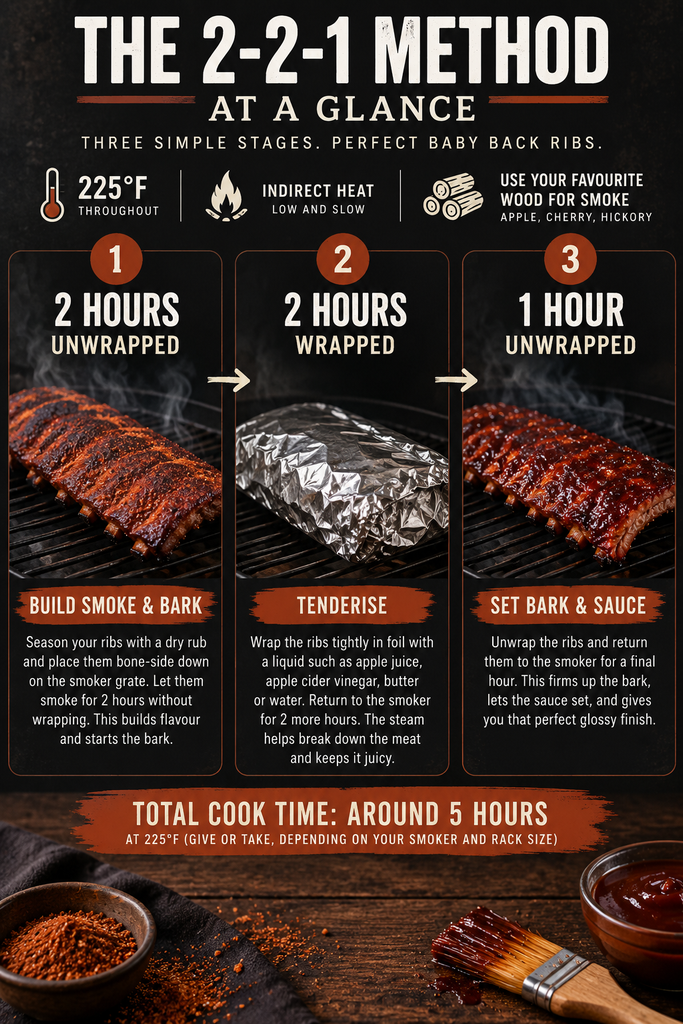
The numbers in 2-2-1 stand for hours at each stage of the cook. You smoke the ribs unwrapped for 2 hours, wrap them in foil with some liquid for 2 more hours, then unwrap them for a final hour to firm the bark and set the sauce. Total cook time lands around 5 hours at 225°F, give or take, depending on your smoker and the size of the rack.
Compare that to 3-2-1, which calls for 3 hours unwrapped, 2 hours wrapped, and 1 hour unwrapped for a total of 6 hours. That extra hour of unwrapped smoke time was designed for spare ribs, which carry more connective tissue and fat and can handle a longer cook without turning to mush. Baby backs simply cannot absorb that much time in the same way.
Baby Backs vs Spare Ribs: Why the Timing Has to Change
Baby back ribs come from higher up on the hog, near the loin, and they are noticeably thinner and leaner than spare ribs. Spare ribs come from the belly side and run longer, meatier, and considerably fattier, which is exactly why they can handle a longer, slower breakdown in the smoker.
That extra fat and connective tissue in spare ribs is not just texture trivia. It is the reason the 3-2-1 timing exists in the first place. Spares need those extra hours to render out the fat and soften the tougher tissue, and they can take the heat because there is more mass to protect the meat from drying out or turning to mush.
Baby backs do not have that buffer. Push them through a full 3-2-1 timeline and the two-hour foil-wrapped braise, which is already doing a lot of tenderizing work, ends up overcooking a rack that was thinner and more delicate to begin with. The result is ribs that separate from the bone in wet clumps rather than pulling away in clean, tender bites.
If you have already read our beginner’s guide to spare ribs, the logic will look familiar. That post walks through the standard timing for spares, and this one is the baby back companion piece. Pick your method based on which cut is actually sitting on your cutting board, not on whichever timing you saw most often online.
Setting Up Your Smoker
Baby back ribs and spare ribs both cook best at the same temperature: 225°F, using indirect heat. Whether you are running a pellet smoker, an offset, or a kettle grill set up for indirect cooking, that low, steady temperature is what gives the meat time to tenderize without drying out the surface.
A couple of setup notes before you start:
- Use a water pan or a drip pan under the ribs to help stabilize temperature and add a little humidity to the cooking chamber.
- Add your wood of choice for smoke flavor. Fruit woods like apple or cherry are gentle and popular for pork, while hickory gives a stronger, more traditional barbecue flavor.
- Trim the membrane off the back of the rack before seasoning. It will not render down in the smoker and can leave the ribs tough and hard to bite through.
If you are still shopping for a smoker setup that can hold steady low temperatures for a beginner-friendly cook, the Ninja Woodfire Outdoor Grill & Smoker is worth a look. It is built to make consistent low-and-slow cooking approachable if you are just getting into smoking ribs at home.
The 2-2-1 Method, Step by Step
Phase 1: 2 Hours Unwrapped
Season your ribs with a dry rub and place them bone-side down directly on the smoker grate at 225°F. Leave them alone for the first 2 hours. This is where the ribs pick up smoke flavor and start forming their bark, the flavorful crust on the outside of the meat.
Resist the urge to open the lid repeatedly to check on them. Every time you open the smoker, you lose heat and add time to the cook. A quick peek at the halfway point is fine, but otherwise let the smoke do its job.
Phase 2: 2 Hours Wrapped
After 2 hours, pull the ribs and wrap each rack tightly in foil along with a liquid of your choice. Apple juice, a splash of apple cider vinegar, a pat of butter, or even just plain water all work well here. This step is often called the “Texas crutch,” and it uses steam to soften the meat quickly.
Return the wrapped ribs to the smoker for 2 more hours at the same 225°F. This is the stage that does the heaviest lifting on tenderness, which is exactly why baby backs only need 2 hours here instead of the fuller wrap time that spare ribs can tolerate.
Phase 3: 1 Hour Unwrapped
Unwrap the ribs carefully, since they will be fragile at this point, and place them back on the grate bone-side down. If you are saucing them, brush on your barbecue sauce now. Let them cook uncovered for a final hour so the bark firms back up and the sauce tacks into a glossy finish rather than staying wet and sticky.
Check for doneness starting around the 45-minute mark of this final hour, since ovens and smokers can run a little hot or cool and every rack is slightly different in size.
How to Know When They’re Done
The single biggest mistake beginners make with any rib method is chasing “fall off the bone” as the finish line. That phrase gets thrown around constantly, but ribs that truly fall off the bone are usually a sign of overcooking. What you actually want is meat that pulls cleanly away from the bone with a gentle tug, leaving a clean bite mark behind.
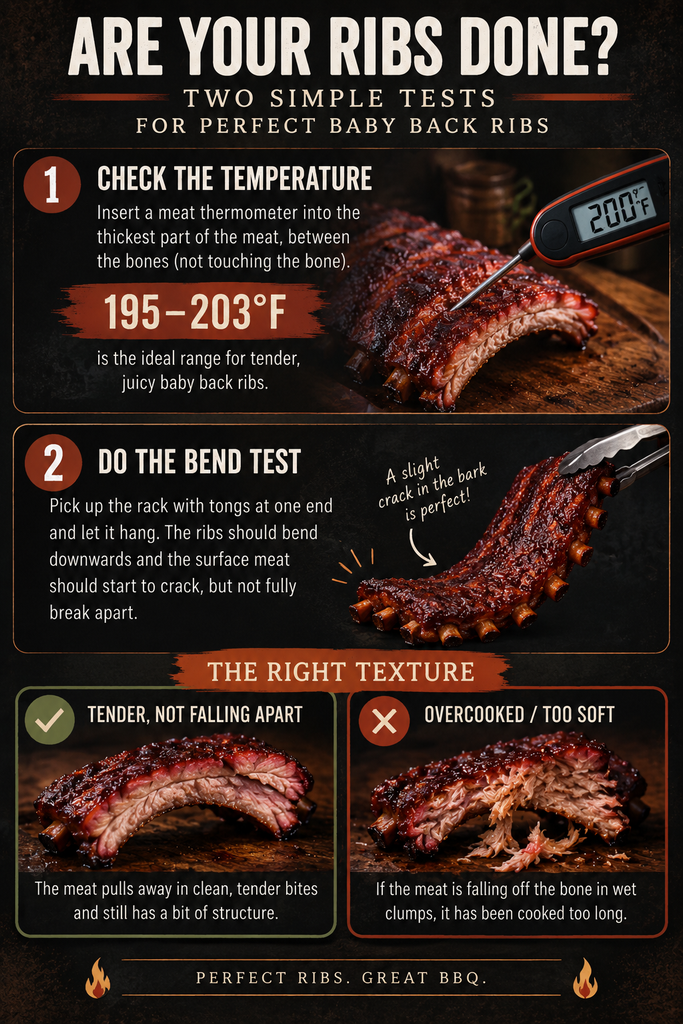
Two checks will tell you far more than a visual guess:
- Internal temperature: Aim for a range of 195°F to 203°F in the thickest part of the rack. This is well above the USDA’s 145°F minimum safe temperature for pork, since that higher range is about breaking down connective tissue for tenderness, not just food safety.
- The bend test: Pick up the rack from one end with a pair of tongs and let it hang. Done ribs will bow into a deep arc, and you should see the surface bark crack slightly along the top. If the rack stays fairly stiff and barely bends, it needs more time.
A reliable instant-read meat thermometer takes the guesswork out of this step entirely. Probe in a few spots, since thickness varies across the rack, and trust the number over how the ribs look on the outside.
The Beginner Mistake to Avoid
The most common misstep with baby backs is treating them like smaller spare ribs and running the full 3-2-1 timeline anyway. It seems like a safe, well-tested method, so why not just use it for any rack of ribs you smoke? The problem is that extra hour of unwrapped smoke time plus the standard 2-hour wrap adds up to real overcooking on a thinner cut.
The two cuts are not interchangeable, and neither is their timing. Spare ribs need the longer 3-2-1 approach to break down properly. Baby backs need the shorter 2-2-1 window to hit that same tender texture without going past it. If you are not sure which rack you are holding, check the shape: baby backs are shorter, more curved, and noticeably leaner, while spare ribs are longer, flatter, and carry a visible strip of fat along one edge.
Troubleshooting: What If They’re Not Done After 2-2-1
Every smoker runs a little differently, and factors like outdoor temperature, wind, and how often you opened the lid can push your cook longer than the standard timeline. If your ribs are not passing the bend test or have not hit 195°F at the end of the full 2-2-1 cycle, do not panic and do not assume the method failed.
Here is what to do instead:
- Rewrap and give it more time. Fold the ribs back into foil and return them to the smoker in 15 to 20 minute increments, checking the bend test and temperature after each round.
- Skip unwrapping again if bark is already set. If the bark already looks good from the earlier unwrapped hour, you can finish the extra time wrapped rather than risk drying out the surface.
- Note the fix for next time. If you consistently need extra time, it may mean your smoker runs cooler than its dial suggests, which is worth knowing before your next cook.
Going a little past the 2-2-1 timeline is completely normal and not a sign you did something wrong. The bend test and internal temperature are the real finish line, not the clock.
Bringing It All Together
The 2-2-1 method exists because baby back ribs are a different cut with different needs than spare ribs, not because barbecue folks enjoy inventing extra numbers to remember. Give your ribs 2 hours of unwrapped smoke, 2 hours wrapped with a little liquid, and 1 hour unwrapped to finish, and check for doneness with a thermometer and the bend test rather than a stopwatch alone.
Once you have this timing down, baby back ribs become one of the easiest, most forgiving things you can smoke on a lazy weekend afternoon. Pair them with your favorite sauce, invite some people over, and let the smoker do most of the actual work.